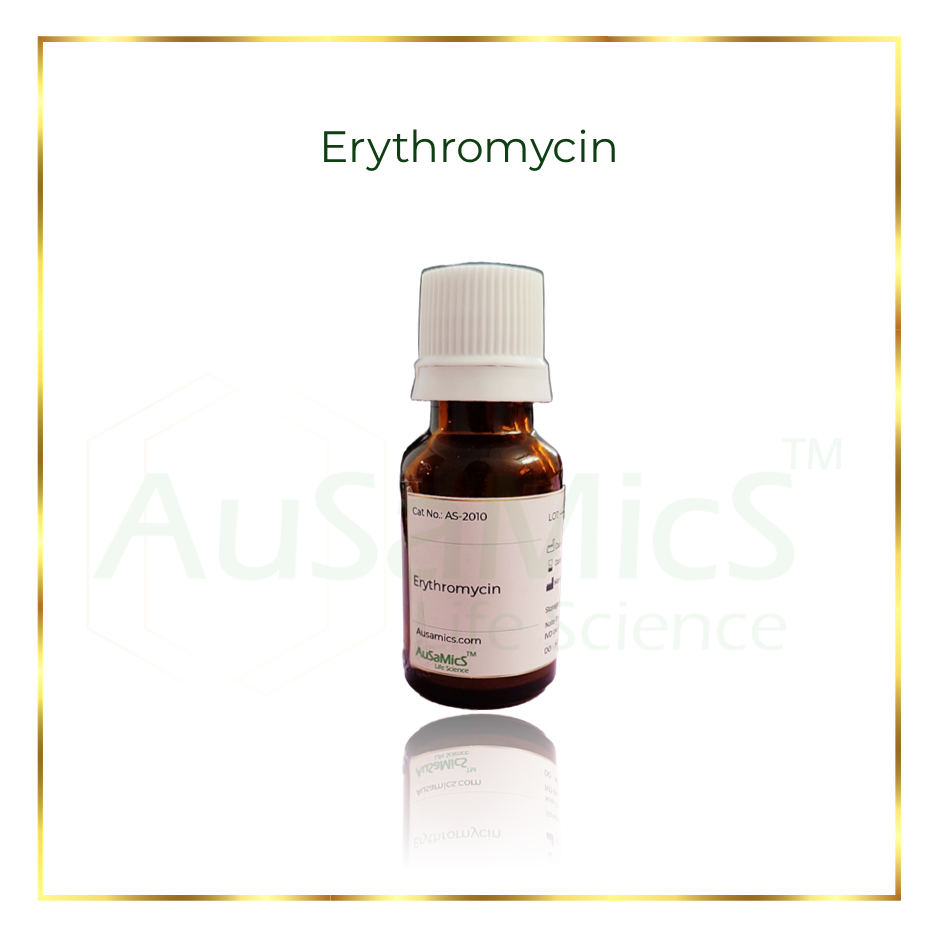
Erythromycin Powder
A broad-spectrum macrolide antibiotic that inhibits protein synthesis by targeting 50S ribosomal subunit
SKU
AS-2010
Category Antibiotics
Catalog Number: AS-2010
CAS Number: 114-07-8
MW: 733.93 g/mol
MF: C37H67NO13
- Description
- Product Information
A powerful macrolide antibiotic with broad-spectrum action against a range of bacterial infections is erythromycin powder. By binding to the 50S ribosomal subunit’s 23S ribosomal RNA in sensitive bacteria, it inhibits protein synthesis by this mechanism of action. A necessary element for the synthesis of peptide bonds during protein translation, the peptidyl transferase center is disrupted by this interaction.
Many Gram-positive bacteria, such as Streptococcus pneumoniae, Enterococcus faecalis, and Staphylococcus aureus, are effectively inhibited by erythromycin. Neisseria gonorrhoeae, Bordetella pertussis, and Legionella pneumophila are just a few of the Gram-negative bacteria that it also exhibits activity against. Interestingly, Chlamydia trachomatis and Mycoplasma pneumoniae are two unusual infections that Erythromycin effectively inhibits.
| Cat. Number | AS-2010 |
| CAS Number | 114-07-8 |
| MDL Number | MFCD00084654 |
| Pubchem | 310272642 |
| Molecular Weight | 733.93 g/mol |
| Molecular Formula | C37H67NO13 |
| Storage Temperature | 4°C |
| Form and Color | Crystalline powder, white |
| Assay (on dry basis) | Min. 85% |
| Thiocyanate | ≤ 0.3% |
| Water | ≤ 6.5% |
| Sulphated ash | ≤ 0.2% |
| Synonym | E-Base / E-Mycin / Erytromycin A |